
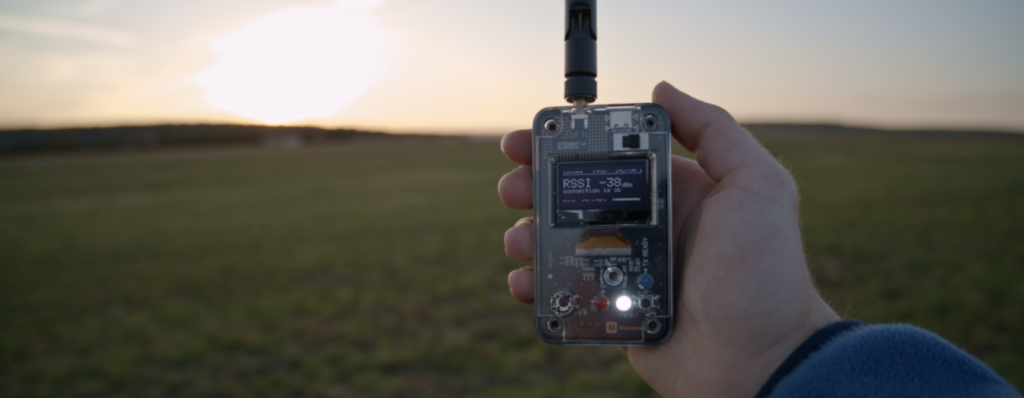
The SteadyBlue Ground Station is the tool used for receiving data from the Reperix tracker. It essentially acts as a two-way radio relay for your Android or iOS smartphone.
SteadyBlue is also Bluetooth-enabled and battery powered, designed for seamless integration with the Reperix Tracking application and autonomous operation.
On the top of the ground station, you’ll find a USB C connector used to connect to your PC and charge the battery, as well as a 2-position switch.
OFF➔ON: To turn on the ground station, slide its switch to the right.
In its resin casing, the body of SteadyBlue measures 5 by 9 by 2 cm and weighs less than 80 grams – fit perfectly in your pocket. By default, it is shipped with a low gain omnidirectional antenna of 20cm that will screw into the top standard SMA connector.
Once powered up the ground station can sustain operation continuously for about 20 hours and will charge as soon as connected through USB, from 0 to 100% in an hour.
Battery percentage is displayed on the idle start screen, and clicking the button will show its real voltage.
SteadyBlue doesn’t need any pairing procedure to be connected to your smartphone, the Reperix Tracking mobile app will automatically search and link to it. When the device is powered up, it goes into a waiting state and will automatically come out of it when you connect it to the application.
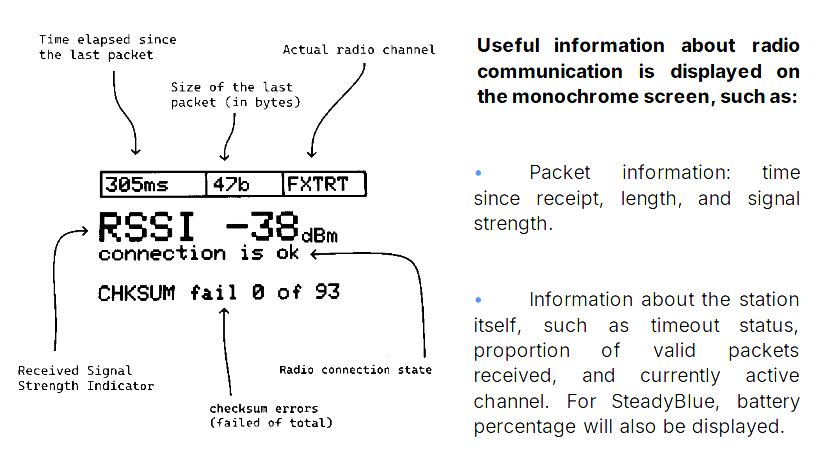
To use several Fluctus at the same time, the Reperix<->SteadyBlue communication system has 26 independent channels (Alpha, Bravo, Charlie…. Zulu) that you can select from. When a communication has been started and no packet has been received for 5 seconds, the connection status goes to “timeout”.
By default, it operates using LoRa 915Mhz modulation exchanging data at 390b/s, on a 500khz radio bandwidth. Each channel is 1Mhz wide.
The frequency (in MHz) of a channel (from 0 to 25) is equal to: 𝟗𝟎𝟐.𝟓 + 𝒄𝒉𝒂𝒏𝒏𝒆𝒍. If using the European EU868-P band, only 2 channels will be available: Alpha (869.4625Mhz) and Bravo (869.5875Mhz).
The RSSI, which stands for Received Signal Strength Indicator, is a numerical value that represents the received signal strength, in dBm (decibel-milliwatt).
The higher (closer to zero) this value, the stronger the signal received.
When a packet is ready to be sent by radio from the ground station to the tracker, it is placed on hold (indicated by the blue LED) and will be sent as soon as the next communication from the tracker is received. This avoids any risk of radio “collision” and guarantees optimal communication.